



Opinions, analysis and commentary
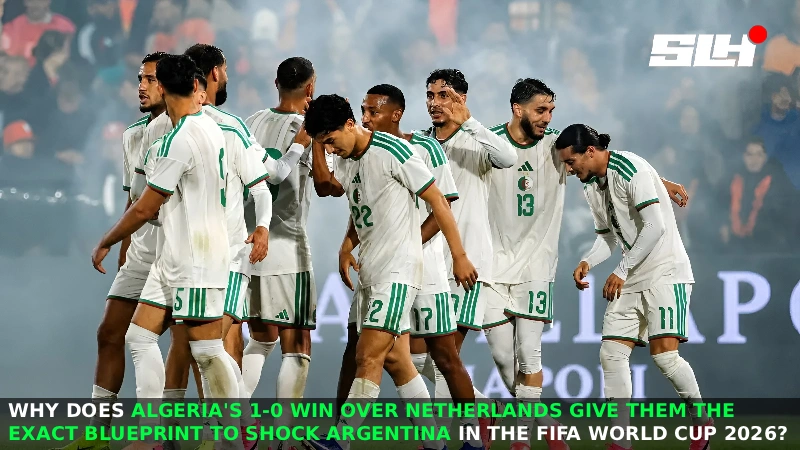


June 17 at Kansas City Stadium, Argentina faced a side that held 30% possession against the Netherlands and still won. Algeria, under Vladimir Petkovic, doesn’t need the ball. They need one moment and a defensive structure that won’t move. Against a Dutch team that generated 2.20 xG without converting, they delivered both. Five clean sheets in six matches entering the tournament confirms this is not a one-game plan. The question now is whether Scaloni has noticed what Petkovic built.
On June 3, 2026, at Stadion Feijenoord in Rotterdam, Algeria surrendered possession completely and won anyway. Donyell Malen hit the woodwork. Tijjani Reijnders had a goal ruled offside. The Dutch finished with 2.20 xG to Algeria’s 0.48.
The winning goal came from substitute Anis Hadj Moussa, who drifted in off the right flank and curled a left-footed strike into the top corner. One chance, one goal. Petkovic’s side sat in compact horizontal lines throughout, pushing the Dutch wide and denying central cutting passes.
| Opponent | Result | Possession | Conceded | Method |
| Sudan | 3-0 W | 45% | 0 | Open play |
| Burkina Faso | 1-0 W | 43% | 0 | Set piece |
| Eq. Guinea | 3-1 W | 46% | 1 | Counter-attack |
| DR Congo | 1-0 W | 42% | 0 | Low block/counter |
| Guatemala | 7-0 W | 60% | 0 | Open play |
| Netherlands | 1-0 W | 30% | 0 | Counter-attack |
Five clean sheets in six matches. This is not a system built for one game. It is Algeria’s identity.
Group J places Algeria alongside Argentina, Austria, and Jordan. Pre-match modelling gives Argentina a 1.74 xG advantage over Algeria’s 1.32, and Scaloni’s side average 68% possession against lower-ranked opposition. Those numbers look one-sided until you apply them to what Petkovic is building.
Algeria’s conversion rate sits at approximately 17%, matching Argentina’s 18%. The Netherlands result showed that one chance at the right moment is enough. The xG model assumes Algeria will chase the game. They won’t. Against an opponent that refuses to leave space, Argentina’s possession percentage fills the statistics sheet, not the net.
Argentina’s attacking system functions best in transition. De Paul wins the ball, Messi receives between the lines. Opponents push forward, and Alvarez or Lautaro find channels behind the defensive line. Neither condition applies against Petkovic’s 4-4-2.
Algeria will not press. They will not push forward. The block pushes opponents toward the sidelines, isolates the ball-carrier, and refuses to give Messi the right half-space he exploits most effectively. When Messi is kept away from that area, Argentina’s attacking threat drops materially. Against deep, disciplined opponents, Scaloni’s side must rely on sustained possession attacks, an environment that has historically produced the fewest goals per game for Argentina.
Riyad Mahrez, at 35, with 113 caps, is the reason Algeria’s low block becomes a genuine threat the moment possession is won. Petkovic builds the entire counter-attacking structure around Mahrez’s ability to receive on the right flank, drive at defenders, and either finish, pull back, or play Amoura in behind.
Mohamed Amoura of Wolfsburg carries 14 goals from World Cup qualification and covers the left wing at speed. Rayan Ait-Nouri of Manchester City overlaps at left-back to stretch Argentina’s defensive width. Ibrahim Maza, 20, of Bayer Leverkusen, adds a midfield accelerator who drives into space when Argentina’s press breaks down. Mahrez is the creative centre. The others are the coordinated system built around him.
The real challenge is endurance. Algeria’s back four and midfield maintained shape for over 70 minutes while the Dutch probed at full pace. Algeria conceded 0.6 goals per game across their recent run and finished qualifying with a 70% win rate, top of CAF Group G, one defeat in ten matches.
The key risk is conceding early. If Argentina scores inside the first 20 minutes, Algeria must chase the game, dismantling the very structure they depend on. Keeping a clean sheet past the hour mark while preserving Mahrez’s legs for a late counter is the exact condition required. It happened at Feijenoord. The Algeria FIFA World Cup 2026 tactical blueprint Argentina upset scenario is credible for one reason: it already worked once, four days before the tournament began.
Stay updated on every twist and turn of the summer transfer window and catch all the live football action with Sports Live Hub (SLH).
Accessing a high-quality hub sports live stream is essential for fans following the matches of the World Cup season. SLH provides a verified directory of official broadcasting partners, ensuring you never miss a moment of the action from the Premier League or Liga Portugal or World Cup.
Our sport hub live streaming dashboard offers real-time tactical overlays, player fitness stats, and live transfer probability tickers. As the WC 2026 saga develops, SLH is the destination for integrated sports data and high-definition viewing.
If you are wondering how to watch Sports live for free, SLH maintains a curated list of official free-to-air (FTA) broadcasters and legitimate digital promotional windows. We help fans find legal, cost-free ways to enjoy global sports while ensuring safety from unauthorized streaming sites.
Did Algeria beat the Netherlands before the tournament?
Yes, Algeria defeated the Netherlands 1-0 in a friendly on 3 June 2026 at Stadion Feijenoord in Rotterdam. Substitute Anis Hadj Moussa scored with a left-footed curler while the Dutch generated 2.20 xG without converting.
What formation does Algeria use at this World Cup?
Algeria uses a compact 4-4-2 low block under Vladimir Petkovic, prioritising defensive shape and denying central space. The system relies on rapid vertical counter-attacks through Mahrez, Amoura, and Ait-Nouri once possession is won.
Who will be Algeria’s coach at the 2026 World Cup?
Vladimir Petkovic is Algeria’s head coach, appointed in February 2024. He has previously managed Lazio, Besiktas, Bordeaux, and the Swiss national team.
Can Algeria beat Argentina in Group J?
Statistically, it is unlikely, with Argentina carrying a 1.74 xG advantage in projections and averaging 68% possession against lower-ranked sides. Algeria’s 1-0 win over the Netherlands on 3 June 2026 showed the low-block system can absorb elite pressure and convert minimal chances.
What is Riyad Mahrez’s role in Algeria’s squad?
Mahrez is Algeria’s captain and the central figure in their counter-attacking system, operating from the right flank as the primary outlet when Algeria win possession. At 35 with 113 caps, his dribbling and finishing make him capable of deciding a match in a single moment.
 football
 football
 cricket