
Opinions, analysis and commentary
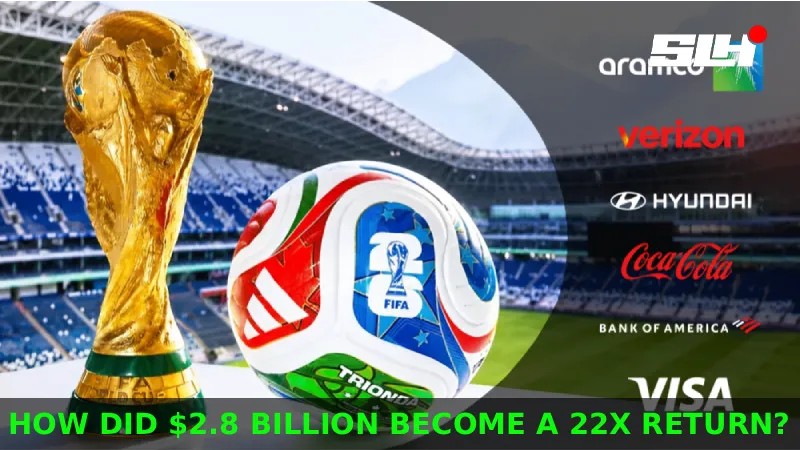


Sponsors paid $2.8 billion in official rights fees for the 2026 World Cup, yet analysts now value the resulting enterprise gain at $61 billion. That multiplier isn’t cash sitting in a vault; it’s the market’s response to brand value climbing across 21 official partners, then compounding through valuation multiples that only apply to companies backed by real balance sheets. Aramco alone added $1.1 billion in brand value, rising from $47.3 billion to $48.4 billion, while smaller, newer partners like Lenovo posted the sharpest percentage gains of the entire field.
The 22x figure needs context before anyone treats it as free money. Twenty-one official partners added $7.2 billion in combined brand value, and that gain is what gets multiplied, not the sponsorship fee itself. Rights payments of $2.8 billion cover slots on the pitch and in broadcasts; they don’t include extra spending on advertising, hospitality and fan activations.
Turning a brand value gain into an enterprise figure means running it through financial multipliers used across company valuations. A billion-dollar rise in brand equity doesn’t add a flat billion to market capitalisation; it cascades through investor expectations until the number multiplies several times over. That’s the mechanism behind the jump from $7.2 billion in brand gains to $61 billion in enterprise value.
Aramco added more value than any other partner in absolute dollar terms, climbing from $47.3 billion to $48.4 billion in estimated brand worth. Verizon wasn’t far behind with a billion-dollar gain, while Hyundai added $836 million and Coca-Cola contributed $733 million.
| Brand | Tier | Brand Value Gain | Uplift |
| Aramco | Tier 1, Global Partner | +$1.1B | +2.3% |
| Verizon | Tier 2, Tournament Sponsor | +$1.0B | Above avg. |
| Hyundai | Tier 1, Global Partner | +$836M | +3.4% |
| Lenovo | Tier 1, Global Partner (2024) | +$295M | +4.2% |
| Kia | Tier 1, Global Partner | +$365M | +3.5% |
| Hisense | Tier 2, Tournament Sponsor | +$19M | +2.1% |
Absolute dollars tell only part of the story once percentage uplift enters the picture. Lenovo’s 4.2 per cent climb and Kia’s 3.5 per cent both beat the field average of 1.6 per cent by a wide margin, even though their dollar totals were far smaller than Aramco’s. Hisense shows that gap clearly: its $19 million gain looks tiny next to the giants, yet its 2.1 per cent uplift still cleared the average.
Lenovo’s 4.2 per cent uplift stands above every other partner on the list, and the timing makes it more impressive. The company only joined the top sponsorship tier in 2024, giving it barely two years to convert a fresh partnership into measurable brand equity.
Kia’s 3.5 per cent and Hyundai’s 3.4 per cent point to a similar pattern among automakers still expanding their global footprint. Brands with room left to grow recognition appear to extract more proportional value from World Cup exposure than household names already near the ceiling of consumer awareness.
Lenovo backed its sponsorship with more than 25,000 devices spread across all 16 tournament venues, running everything from referee review cameras to team analytics systems. That scale of deployment gave the brand a functional presence at the tournament rather than just a logo on a perimeter board.
Company leadership had openly worried about being remembered only as a computer maker once the final whistle blew. The 4.2 per cent brand value uplift suggests that risk didn’t materialise, and that fans came away associating Lenovo with more than just hardware.
American Airlines and Marriott both closed with uplifts of just 0.5 per cent, the lowest of any sponsor tracked. Softer-than-expected travel demand across host cities appears to be the drag, since both brands depend directly on visitors showing up in person rather than watching from home.
Visa’s modest percentage gain tells a different story. Its real payoff isn’t measured in brand value points at all; it’s the exclusivity of holding the payments category, since Mastercard simply can’t buy its way into that space while the contract runs.
Put together, these swings prove that World Cup 2026 sponsors’ ROI brand value isn’t distributed evenly across the sponsor pool. Transactional giants with near-universal recognition have less room to climb, while challengers still building global trust have the most to gain from four weeks in the spotlight.
Which sponsor do you think banks the better long-term payoff, Lenovo’s fast climb or Visa’s locked-in exclusivity? Drop your pick and the reasoning behind it.
As football fans globally search for the most reliable platforms to witness history unfold—especially with Argentina currently attempting to join this exclusive list in the 2026 World Cup Final—Sports Live Hub (SLH) emerges as the ultimate destination for premium sports broadcasting.
Finding a secure, uninterrupted broadcast during major international tournaments can be incredibly frustrating due to complex regional restrictions and geo-blocks. The hub sports live stream feature available on SLH operates as a state-of-the-art intelligent aggregator. It seamlessly maps your location and automatically routes you to verified, official regional broadcast feeds. This ensures that fans can watch every crucial moment of the World Cup in stunning high-definition, completely free from the irritating buffering issues and dangerous malware threats associated with illegal, unverified streaming websites.
Modern football enthusiasts demand a highly analytical and interactive viewing experience. The sport hub live streaming interface on SLH serves as an elite second-screen companion for dedicated fans. As you watch the world’s best teams compete for international glory, the platform provides dynamic, real-time digital overlays. Viewers gain instant access to advanced tactical data, including live Expected Goals (xG), detailed passing networks, and comprehensive player heatmaps, empowering them to dissect the beautiful game just like a professional television pundit.
During monumental events like a World Cup Final, internet searches for how to watch Sports live for free inevitably skyrocket. SLH proactively solves this challenge by maintaining a meticulously curated, fully localized directory of legal, free-to-air (FTA) broadcasting networks. By specifically highlighting public broadcasters that legally air these premium matches without requiring expensive subscription paywalls, SLH guarantees that the unparalleled excitement of international football remains completely accessible, safe, and entirely legal for millions of passionate fans worldwide.
How much did World Cup 2026 sponsors spend in total?
Sponsors committed $2.8 billion in official rights fees for the tournament. That figure excludes the additional money brands spent on advertising, hospitality and fan experience campaigns built around their sponsorships.
Which brand gained the most value from the 2026 World Cup?
Aramco gained the most value in absolute terms, adding $1.1 billion in brand value. Lenovo led on percentage growth at 4.2 per cent, ahead of Kia and Hyundai.
What is the methodology behind the $61 billion enterprise figure?
The $61 billion applies financial market multipliers to a $7.2 billion combined brand value gain across 21 sponsors. It reflects how brand growth translates into company valuations rather than an actual cash sum.
How many official sponsors did the 2026 World Cup have?
FIFA sold all 16 global sponsorship slots, and analysts tracked 21 sponsors once regional partners were included. Seven were Tier 1 Global Partners, eight were Tier 2 Tournament Sponsors, and the rest were regional supporters.
Did Lenovo sponsor the 2026 World Cup?
Yes, Lenovo joined as Official Technology Partner and Tier 1 Global Partner in 2024. It deployed 25,000+ devices with 99.99 per cent uptime across all 16 venues and posted the highest brand value uplift of any sponsor.
 cricket
 football
 football