

Opinions, analysis and commentary


Two separate FIFA cases are following Argentina out of the 2026 World Cup, and only one of them is a routine disciplinary matter. The brawl involving Paredes and Molina will likely end in individual bans, the standard outcome for that kind of on-field misconduct. The banner case is different in kind entirely, tied to a live sovereignty dispute rather than a scuffle after the final whistle, and it carries consequences that reach well past the tournament itself and into diplomatic territory FIFA rarely has to navigate.
Argentina’s 2026 run ended with two open disciplinary files sitting on FIFA’s desk at the same time. The first covers the post-final conduct against Spain, where Leandro Paredes confronted Eric Garcia and Nicolas Molina had a separate incident with Rodri in the tunnel area. That case points toward individual misconduct bans, a standard outcome FIFA has handed down many times before for on-field flashpoints between rival players.
The second case is harder to close quietly. It concerns a political banner Argentina’s own players displayed after beating England in the semi-final, and its implications sit far outside the normal disciplinary playbook that governs shoving matches, confrontations and the usual post-match tempers.
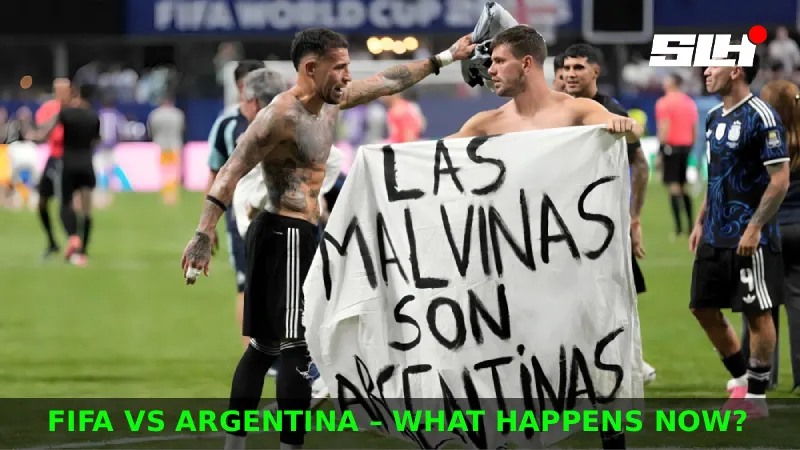
Argentina beat England 2-1 at Atlanta Stadium on July 15, 2026, in a comeback win that briefly overshadowed everything else. Giovani Lo Celso took a banner handed to him by fans and held it up on the pitch, reading Las Malvinas son Argentinas, before Lisandro Martinez, Cristiano Romero and Nicolas Otamendi joined him, and the banner was laid across the turf for photographers. Argentina’s vice president posted a photo of the moment soon after, framing it publicly as a message the squad carries regardless of stadium rules or FIFA’s own code of conduct.
FIFA opened a formal case within 24 hours, moving faster than it typically does on political-content complaints of this kind, a pace that signals how seriously the governing body is treating it.
This is not new territory for the Argentine federation, which has walked this exact line once before. Before a friendly against Slovenia in La Plata on June 7, 2014, players displayed the same banner. FIFA ruled that display breached its political-action regulations and fined the federation 30,000 Swiss francs, worth roughly $33,000 at the time, alongside a formal reprimand attached to the case file.
The 2026 repeat carries sharper stakes than that earlier episode ever did. It happened mid-tournament, in a World Cup semi-final, against England specifically, the country on the other side of the underlying sovereignty dispute, and in front of the largest global television audience the sport produces anywhere.
A misconduct charge produces a predictable outcome: a fine, maybe a short suspension, then the story quietly fades from view. The banner case cannot fade the same way, because the Falklands dispute killed 910 people in 1982 and remains politically active on both sides even now. When Argentina’s president publicly defended the display while still expecting a fine to follow, he confirmed that government backing adds a layer that standard disciplinary proceedings were never really built to absorb.
There is precedent for individual punishment too, not just fines against federations. FIFA banned South Korean player Park Jong-Woo for two matches after he displayed a territorial banner at the 2012 London Olympics, proof that individual players, not only national federations, can face real consequences here.
The 2014 fine and reprimand almost certainly set the floor rather than the ceiling this time around. A World Cup semi-final against the exact country involved in the dispute carries far more visibility than a pre-tournament friendly ever did, and Lo Celso and Martinez are now the two most photographed participants in the entire unfolding episode, a detail FIFA’s disciplinary panel is unlikely to overlook.
That gap between precedent and this year’s circumstances is exactly why the Argentina Las Malvinas banner FIFA investigation matters more than the brawl case running alongside it in the same disciplinary cycle. Whether FIFA escalates beyond a fine will show how it weighs political sensitivity against its own past rulings, and the eventual answer will likely shape how the governing body handles the very next politically charged banner that lands on its desk.
Do you think FIFA should punish the players individually, or is a federation fine enough here? Tell us your take below.
As football fans globally search for the most reliable platforms to witness history unfold—especially with Argentina currently attempting to join this exclusive list in the 2026 World Cup Final—Sports Live Hub (SLH) emerges as the ultimate destination for premium sports broadcasting.
Finding a secure, uninterrupted broadcast during major international tournaments can be incredibly frustrating due to complex regional restrictions and geo-blocks. The hub sports live stream feature available on SLH operates as a state-of-the-art intelligent aggregator. It seamlessly maps your location and automatically routes you to verified, official regional broadcast feeds. This ensures that fans can watch every crucial moment of the World Cup in stunning high-definition, completely free from the irritating buffering issues and dangerous malware threats associated with illegal, unverified streaming websites.
Modern football enthusiasts demand a highly analytical and interactive viewing experience. The sport hub live streaming interface on SLH serves as an elite second-screen companion for dedicated fans. As you watch the world’s best teams compete for international glory, the platform provides dynamic, real-time digital overlays. Viewers gain instant access to advanced tactical data, including live Expected Goals (xG), detailed passing networks, and comprehensive player heatmaps, empowering them to dissect the beautiful game just like a professional television pundit.
During monumental events like a World Cup Final, internet searches for how to watch Sports live for free inevitably skyrocket. SLH proactively solves this challenge by maintaining a meticulously curated, fully localized directory of legal, free-to-air (FTA) broadcasting networks. By specifically highlighting public broadcasters that legally air these premium matches without requiring expensive subscription paywalls, SLH guarantees that the unparalleled excitement of international football remains completely accessible, safe, and entirely legal for millions of passionate fans worldwide.
What does the Las Malvinas banner phrase actually mean?
It translates to The Falklands are Argentine, Argentina’s claim over the Falkland Islands. Britain and Argentina fought a ten-week war over the islands back in 1982.
Did Argentina really beat England at the 2026 World Cup?
Yes, Argentina won the semi-final 2-1 at Atlanta Stadium on July 15, 2026. They went on to lose the final to Spain 1-0 after extra time.
What do FIFA’s rules say about political statements?
FIFA’s Disciplinary Code bans political messaging inside stadiums during official matches worldwide. Players and federations can be charged under its provocative-action and political-action regulations, both written into the same code.
Has FIFA punished a political banner before this incident?
Yes, in 2014 FIFA fined Argentina’s federation for the exact same banner. The fine was 30,000 Swiss francs, roughly $33,000 at the time, plus a formal reprimand on record.
What happened in the Argentina versus Spain final brawl?
Paredes confronted Garcia and Molina clashed with Rodri after Spain’s narrow 1-0 win. That July 19 incident triggered a completely separate FIFA investigation into Argentina’s post-match conduct.
 cricket
 football
 football