

Opinions, analysis and commentary
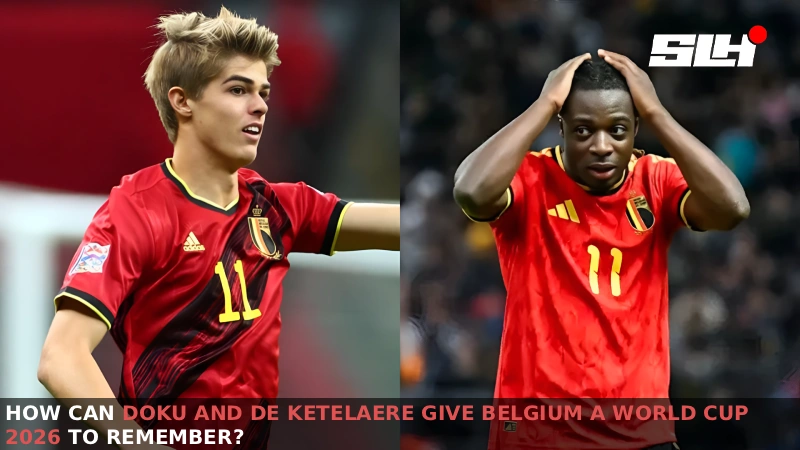


Belgium’s golden generation never had this problem solved , the left channel that opens space, and the intelligent runner arriving into it. Doku and De Ketelaere aren’t just two exciting attackers; they’re a specific tactical mechanism that bypasses the central congestion opponents used to suffocate Belgium for a decade. Whether that mechanism holds under knockout pressure is the only question that matters now.
The structure was the problem, not the players. Martinez’s 3-4-2-1 funnelled everything through central zones , De Bruyne and Hazard operating in tight spaces where organised defences were most comfortable defending. Belgium averaged 14.2 shots per match under Martinez in qualifying, clinical but narrow, always dependent on individual moments rather than systemic width. When opponents sat deep and denied those central entries, Belgium had no reliable mechanism to stretch them. Doku wasn’t in the team. The left channel wasn’t a weapon. It was just an area opponents ignored.
Thirty-six completed take-ons and 51 chances created in a single Premier League season. Those aren’t peripheral winger numbers , that’s elite ball-progression output from someone who wins one-versus-one situations at a rate that changes how defences have to organise. Doku finished 2025–26 with five goals and five assists for Manchester City, but the raw stats understate his value. His real contribution is the defensive disruption he forces before the ball even reaches him , isolated fullbacks, compressed backlines, cutback corridors that didn’t exist until he started running.
In qualifying, he carried that form directly into the Belgium shirt: five goals and three assists in eight games, including a first-half brace against Liechtenstein on 34 and 40 minutes that set the tone for a 7-0 demolition.
De Ketelaere’s 2025–26 season at Atalanta produced 45 chances created and 0.24 xA per 90 in Serie A, with those numbers rising to 15 chances created and 0.29 xA per 90 in the Champions League, improving against better opposition, which is exactly the pattern you want from a player heading into a World Cup. He added two goals and two assists in five qualifying appearances, including a second-half brace in the Liechtenstein match after Doku had already created the opening. His value isn’t volume finishing. It’s the ability to receive in half-spaces, turn under pressure, and play the ball that unlocks the next line, the creative function Martinez never had a proper structural solution for.
Garcia’s qualifying numbers tell the story: 2.88 goals per game, 18.4 shots per match, leading the entire UEFA region in successful dribbles per 90. That’s a different team from Martinez’s patient 3-4-2-1 possession structure, which averaged 14.2 shots per game and routed everything through central zones. Garcia uses Doku to create a field tilt, permanent width, and a permanent threat on the left, which compresses Egypt’s backline horizontally and forces Iran’s midfield anchor to track runners before it’s settled. De Ketelaere occupies the space that creates. Against New Zealand’s physically imposing but pace-limited centre-backs, Belgium’s high press traps the defensive line, and Doku wins take-ons in the penalty area before the recovery run is even possible. Three opponents, three different defensive shapes, one consistent answer: Doku stretches, De Ketelaere exploits.
The group stage is winnable. Belgium has the attacking mechanism to break down all three opponents in Group G. The harder question is whether Doku and De Ketelaere can do it against sides with better defensive organisation than Egypt, Iran, or New Zealand. Their combined 11 qualifying contributions came largely in comfortable matches. The Liechtenstein 7-0 was the peak, not the benchmark. What Garcia needs in the knockouts is the same output in a match where the opponent is compact, the margins are fine, and Doku can’t get two or three take-on attempts before something opens. That’s the version of this partnership nobody has seen yet.
Stay updated on every twist and turn of the summer transfer window and catch all the live football action with Sports Live Hub (SLH).
Accessing a high-quality hub sports live stream is essential for fans following the matches of the World Cup season. SLH provides a verified directory of official broadcasting partners, ensuring you never miss a moment of the action from the Premier League or Liga Portugal or World Cup.
Our sport hub live streaming dashboard offers real-time tactical overlays, player fitness stats, and live transfer probability tickers. As the WC 2026 saga develops, SLH is the destination for integrated sports data and high-definition viewing.
If you are wondering how to watch Sports live for free, SLH maintains a curated list of official free-to-air (FTA) broadcasters and legitimate digital promotional windows. We help fans find legal, cost-free ways to enjoy global sports while ensuring safety from unauthorized streaming sites.
How good is Jeremy Doku at the 2026 World Cup?
Doku is one of the most dangerous wide players at the tournament. His 36 completed take-ons and 51 chances created in the Premier League, plus five qualifying goals in eight games, make him the one-versus-one threat Belgium’s previous generations never had.
What position does Charles De Ketelaere play for Belgium?
De Ketelaere plays as a No.10 or false forward, receiving in half-spaces and linking midfield to attack. His xA per 90 rose from 0.24 in Serie A to 0.29 in the Champions League; he gets better against better opposition.
Who are Belgium’s best attackers at the 2026 World Cup?
Doku and De Ketelaere are Belgium’s most important attacking players, combining for 11 qualifying contributions. Trossard provides a third option, with Lukaku and De Bruyne offering impact if both arrive fit.
How did Belgium qualify for the World Cup 2026?
Belgium qualified through UEFA’s European campaign, averaging 2.88 goals per game under Garcia. They led the entire UEFA region in successful dribbles per 90, built around Doku’s width and De Ketelaere’s creativity.
Can Belgium win the 2026 World Cup?
A first title remains unlikely, but Belgium has a structural attacking plan that previous squads never had. A quarter-final is the floor; going further depends on Doku and De Ketelaere delivering against elite knockout opposition.